TCP 3-Way Handshake Process
The TCP 3-Way Handshake is a process used by the Transmission Control Protocol (TCP) to establish a reliable connection between a client and a server before data transfer. It ensures that both sides are synchronized and ready to communicate.
Problems TCP is designed to solve
Without TCP, applications would need to handle these problems themselves:
Packet loss.
Out-of-order delivery.
Data Corruption.
Network Congestion
Flow control.
TCP 3-way Handshake Process
Communication over the internet follows the TCP/IP model. Applications like web browsers use the Application Layer, and their data is passed to the Transport Layer, where TCP and UDP work.
TCP is widely used because it provides reliable communication.
UDP is faster but unreliable (e.g., used in DNS lookups).
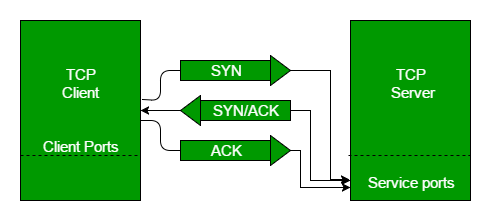
Step 1 (SYN): In the first step, the client wants to establish a connection with a server, so it sends a segment with SYN(Synchronize Sequence Number) which informs the server that the client is likely to start communication and with what sequence number it starts segments with
Step 2 (SYN + ACK): Server responds to the client request with SYN-ACK signal bits set. Acknowledgement(ACK) signifies the response of the segment it received and SYN signifies with what sequence number it is likely to start the segments with
Step 3 (ACK): In the final part client acknowledges the response of the server and they both establish a reliable connection with which they will start the actual data transfer.
How data transfer works in TCP
Segmenting
When an application sends data (like an email or file), TCP breaks the data into smaller chunks called segments.
Each segment has a header containing information like sequence numbers, ports, and flags.
This makes it easier to send large amounts of data over the network reliably.
Routing via IP
Once TCP creates segments, they are handed to IP (Internet Protocol).
IP is responsible for delivering the segments from the sender to the receiver, possibly through multiple routers.
TCP doesn’t care about the path—IP handles routing and addressing.
Reassembly at Receiver
Segments may arrive out of order because they can take different paths through the network.
TCP at the receiver uses sequence numbers to reassemble the segments into the correct order to reconstruct the original message.
Retransmission
If the sender does not receive an acknowledgment within a certain time, it resends the missing segment.
This ensures no data is lost, making TCP reliable.
and lot more..
How TCP Ensures Reliability, Order, and Correctness
Retransmission
TCP retransmits the missing segment if an ACK is not received in timeOrder (Sequence Numbers)
Every byte has a sequence number. Receiver get Buffers out-of-order segments and reassembles data correctly.
How a TCP Connection Is Closed
TCP connection termination is the process of closing an established TCP connection between two devices in an orderly way. It uses a four-step handshake (FIN-ACK exchange) to ensure that both sides have finished sending and receiving all data before the connection is fully closed.
Types of TCP Connection Release
TCP supports two types of connection releases like most connection-oriented transport protocols:
Abrupt connection release: In an Abrupt connection release, either one TCP entity is forced to close the connection or one user closes both directions of data transfer.
Graceful connection release: In the Graceful connection release, the connection is open until both parties have closed their sides of the connection.
TCP is the protocol that turns an unreliable network into a reliable communication channel by using connections, acknowledgments, retransmissions, and flow control.


